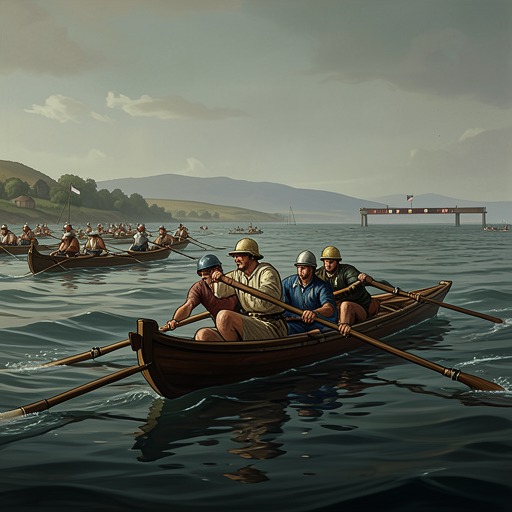
George Morry
The Boys in the BoatGeorge Morry was the coxswain who gave the Washington freshmen a voice, a shared point of attention, and a tactical hand at the critical end of a race. His role was not simply to call commands: as the crew struggled, won, and later faced stronger competition, Morry helped translate collective discipline into pace and timing. His career in the evidence moves from a mantra that failed to restore the boat’s form to controlled surges that delivered emphatic victories—and, against California, a defeat by only two feet.
Identity and Place in the Crew
Morry coxed the Washington freshmen during the season in which they prepared to race California and pursue the national freshman championship. The position placed him at the center of the crew’s coordination. The oarsmen depended on synchronized strokes, while the coxswain supplied commands and helped keep attention inside the boat. The book describes rowing as unusually vulnerable to an individual lapse: one rower’s poor concentration or mistimed stroke could disturb the tempo and balance of the whole shell. Morry’s voice therefore served a practical purpose. It was part of the mechanism by which eight separate efforts could become one crew.
That responsibility also made him a focal point when the boys’ confidence shifted. In the opening stretch of the season, the freshmen were struggling to recover their form. Morry responded by chanting “M-I-B, M-I-B, M-I-B!” to the rhythm of their stroke. The letters stood for “mind in boat”: a reminder to attend to the rower ahead, the coxswain’s commands, and the work within the gunwales rather than distractions outside. The phrase gave the crew a compact language for concentration, but repetition alone did not solve the problem. The freshmen continued to struggle, and Tom Bolles decided that the boat’s mechanics needed attention. Morry’s mantra marked the crew’s shared effort to regain focus, not an instant cure.
Learning to Control the Race
A later training race showed a more effective combination of patience and command. The junior varsity began with a three-length handicap, while the freshmen were instructed to stop at two miles so the coaches could record their time under racing conditions. The starting signal caught the varsity coxswain talking, and the freshmen opened half a boat length on the older crew. They then held a moderate rate, remaining behind the handicapped junior varsity but gradually moving ahead of the varsity. At a mile and a half, they had begun to close on the leaders without increasing their stroke rate.
With a quarter mile left, Morry judged that his crew had enough in reserve and called for the rate to rise by a couple of notches. The freshmen surged past the junior varsity and took the overall lead. At two miles, Morry called “Way ’nuff,” and the boys stopped rowing two full lengths ahead of the other boats. They let their oars ride the water and coasted while the older crews passed. The result gave Bolles a striking time and convinced him that the boat had exceptional potential. The episode introduced a pattern that would recur: Morry held the crew to a measured pace, then asked for more only when the finish was near and the boys had strength left to spend.
The California Victory and National Title
The stakes were greater when the Washington freshmen met the California crew on Lake Washington. Joe Rantz sat at number three and Roger Morris at number seven. The boys faced a stiff north breeze and knew that months of training would be tested in a race demanding more than three hundred strokes from each oarsman. In a shell with eight rowers, every stroke had to enter and leave the water cleanly; a single crab could undo the crew’s work. Morry’s task was to keep the boat’s attention on its own performance amid the pressure of the race.
Washington gradually moved past California while maintaining a low rate. By the mile, the Huskies had open water. California’s coxswain called for powerful strokes twice, but the Washington lead remained intact and grew. Near the finish, with Washington already four lengths ahead, Morry finally called for a higher rate. The boys moved first to thirty-two strokes per minute and then to thirty-six, crossing the line four and a half lengths ahead and almost twenty seconds faster than the freshman course record, despite the headwind. The victory culminated in the traditional exchange of trophy shirts: the Washington boys collected jerseys from their defeated rivals, shook hands with them, and returned to their shell. Rantz then carried a California jersey onto the student ferry and found Joyce in the crowd.
Morry’s late calls mattered again in the national freshman championship on the Hudson River. Washington had moved in front of Syracuse University without raising its rate, and by the mile and a half the lead was two and a half lengths. A Syracuse rower caught a crab, but the crew recovered its rhythm. Morry looked back, saw the size of Washington’s advantage, and nevertheless called up the rate over the final few hundred feet. The boys crossed five lengths ahead. Afterward they collected the Syracuse crew’s shirts and shook hands with their opponents. The celebration continued back at the shell house, where four teammates seized Morry, swung him by his arms and legs, and flung him into the Hudson. The ritual made the coxswain, usually the voice directing the crew, the center of the crew’s exuberant celebration.
The Fifth Boat and a Narrow Defeat
The next season brought a complicated sign of how the program viewed Morry’s group. When Al Ulbrickson posted tentative crew assignments, the boat from the previous year’s freshman first was the only intact crew among the five potential varsity boats. Morry remained its coxswain, with George Lund at bow, Shorty Hunt at two, Rantz at three, Chuck Hartman at four, Bob Green at six, and Morris at seven. Yet Ulbrickson placed the boat fifth, the lowest position on the list. Its members were glad to row together again and knew that the unit had worked well, but the placement felt like a demotion after their championship. Their swagger gave way to uncertainty under a harder coach and a more demanding season.
In a later race against the California crew, Morry faced a different test: resisting a sprint rather than initiating one. Ulbrickson had instructed him to keep the rate low as long as possible. California surged to forty strokes per minute and briefly moved ahead, while Washington stayed at thirty-four. Morry did not answer the rate with another immediate increase. He judged that his crew still had power and that California might have spent too much of its own, then called “Gimme ten big ones!” Washington’s boat leapt forward and drew even. Morry called for ten more as the finish approached, and the two shells passed under the bridge side by side.
The result was announced amid confusion. Flags dropped together, spectators disagreed about which bow had crossed first, and the official loudspeaker declared California the winner by two feet. The loss did not erase the pattern visible across Morry’s races: he could hold a crew to a low rate, read its remaining strength, and call for a final effort at the point of maximum consequence. But the narrow defeat also made clear that sound judgment and a powerful finish could not guarantee victory. Morry’s narrative role lies in this tension between control and uncertainty: his calls gave the crew a means to act together, while the outcome still depended on the razor-thin margins of competition.